

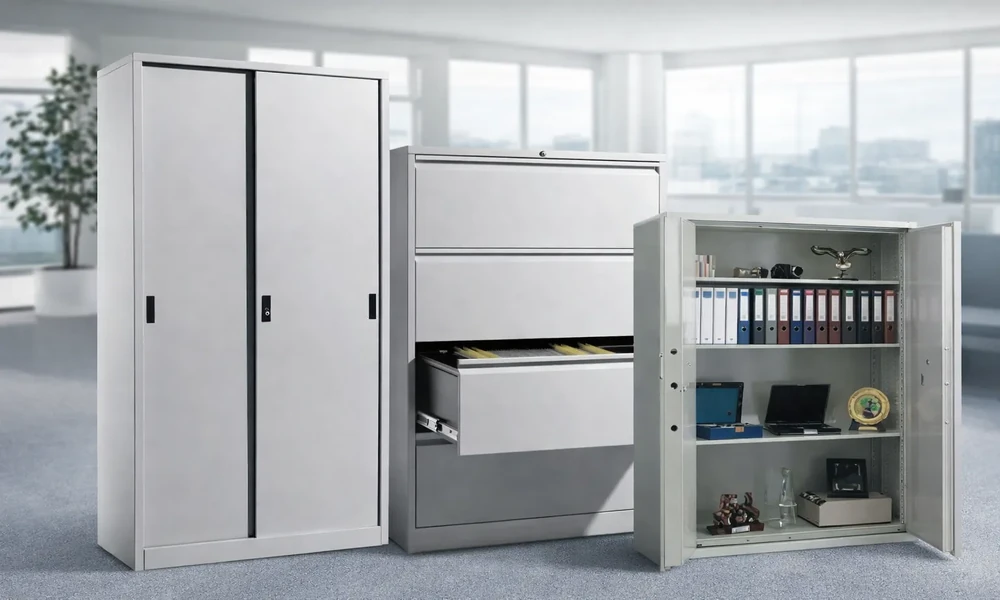
Paperwork was supposed to disappear. Instead it moved to a cupboard nobody has audited in three years, which is a problem when the cupboard contains employment records, signed contracts and customer information covered by data protection obligations. Choosing metal cabinets singapore offices actually need starts with what is being stored and who must be prevented from reaching it, not with the dimensions of the available wall.
Why Steel Rather Than Timber
Steel cabinets resist humidity in a way that particleboard does not, and Singapore’s climate is unforgiving to laminated chipboard once a joint absorbs moisture. Steel also carries weight without sagging, which matters because a drawer of A4 files is heavier than it looks. It does not harbour insects, it does not swell, and a powder-coated finish survives fifteen years of trolleys knocking into it. For long-term storage of anything valuable or heavy, the material choice is not really a contest.
Swing Door Cupboards
The general-purpose workhorse is a full-height cupboard with two hinged doors and adjustable shelves. It suits box files, stationery, samples and equipment, and the shelves reposition as contents change. The practical constraint is clearance: both doors need space to open fully, which rules the format out in tight corridors and behind desks. Check that the shelves are supported on multiple points rather than two clips, because a shelf carrying twenty box files will bow if it is not.
Sliding Door and Roller Shutter Units
Where clearance is limited, sliding doors give access without swinging into circulation. The trade-off is that only half the interior is reachable at any moment. Roller shutter cabinets solve both problems, opening the full width with no door swing at all, and locking with a single point at the base. They cost more and the shutter mechanism is the part most likely to need attention over time, so ask what happens if it jams and whether replacement slats are available.
Filing Cabinets and Drawer Units
Vertical filing cabinets in two, three or four drawer formats remain the standard for suspension files, and mobile pedestals slot under desks for personal storage. Two details separate good from poor. Drawer runners should be full-extension and ball-bearing rather than roller, so the back of the drawer is actually reachable. An anti-tilt interlock should prevent more than one drawer opening at once, because a four-drawer cabinet with two loaded drawers extended will tip forward onto whoever opened them.
Mobile Shelving Where Space Is Tight
Where a records room is running out of floor, mobile shelving on rails removes the aisles. Banks of shelving slide along tracks so only one aisle is open at a time, typically increasing capacity by half again in the same footprint. The costs are a loading requirement on the floor slab, a longer installation, and the inconvenience of one person at a time retrieving files. For an archive accessed weekly it is an excellent trade; for live filing accessed hourly it is not.
Locking and Access Control
A cam lock securing a single point deters casual curiosity and nothing more. Three-point locking, engaging at the top, middle and bottom of the door, is what actually resists a determined pull. Consider who holds keys and what happens when someone leaves; master-keyed suites let facilities open any unit while individual users retain their own. Digital or combination locks remove the key problem entirely and introduce a battery one, so check whether there is an emergency override.
Fire-Resistant Cabinets Are a Different Product
A standard steel cabinet offers essentially no protection to its contents in a fire; the steel survives and the paper inside does not. Genuine fire-resistant cabinets are insulated units tested to a stated rating for a stated duration, and they are considerably heavier and more expensive. If original signed documents, certificates or backup media must survive an incident, this is the category to specify. Anyone comparing steel storage cabinets should be clear which of the two they are actually buying.
Storage and Data Protection Obligations
Personal data held on paper falls under the same protection obligations as data held on a server, and a cupboard anyone can open is not reasonable security. In practice this means locked storage for personnel files, applicant records, medical information and customer documents, with a defined list of who holds keys. It also means having a retention policy, because documents kept indefinitely are a liability rather than an asset. A locked cabinet is only half the control; the other half is knowing what is inside it.
Build Quality Details Worth Checking
Ask the steel gauge, since thinner sheet flexes and dents and the difference is invisible in a photograph. Look at whether edges are folded and welded or simply cut, both for rigidity and because an unfinished edge cuts hands. Check that the unit sits on levelling feet, which matter more than expected on the uneven screed common in older industrial units. Confirm the finish is powder coating rather than paint, and ask about the load rating per shelf rather than accepting a general assurance.
Placing and Securing Them
Tall cabinets should be anchored to a wall or bolted to each other, particularly filing units, and this is a five-minute job that prevents a serious injury. Keep heavy items in lower shelves and drawers. Leave enough clearance for doors and drawers to open fully, measured rather than estimated. Confirm delivery access, since a full-height cabinet will not fit in every lift, and ask whether the supplier assembles and positions the units or leaves them flat-packed at the loading bay. Well-specified metal cabinets singapore businesses install properly will outlast two or three office moves.